



Planning an international journey with a large dog can raise practical questions: will their crate fit on the aircraft, how will you get them to the airport, and what needs arranging before departure?
Getting these details sorted early gives you more time to prepare your dog and organise the journey around their needs. From crate sizing and flight availability to paperwork and arrival arrangements, here’s what to consider before you travel.
Why flying a large dog can be more complicated
If a scheduled airline requires your dog to travel as cargo, you will need to meet its crate and import requirements of the destination country.
For air travel crates, the dog must be able to sit, stand, lie down and turn around in a natural position. This can make the crate substantially larger than owners expect, particularly for tall or long-bodied breeds. IATA crate requirements apply to all air transport and owners and transporters share responsibility for compliance.
For a giant breed, a correctly sized crate can therefore be a significant practical consideration. At PetAir we can provide crates for all sized dogs, no matter the size. We can add extension pieces to our plastic crates or use bespoke wooden crates where necessary. However, the cost usually increases due to the amount of space it will take up in the cargo hold. This is why some large dog owners consider in-cabin travel instead, where a crate is not needed. Here, all dogs cost the same to travel, no matter the size.
Larger crates might make it more difficult to transport your pet to and from the airport. This includes lifting the crate yourself, as well as fitting it in your car. Speak to our team at PetAir – we will talk you through your options. In this case, opting in for our door-to-door pickup might be a good option for you.
Option 1: Large dogs travelling in the hold or as cargo
Your dog travels in a secure, compliant crate and is handled through the airline’s animal transport procedures. They will travel in the hold of the aircraft – a space specifically for live animals.
If this is the route you choose, plan early. Your pet’s crate must be suitable for their dimensions, the airline must accept the animal on that specific route, and the destination country’s documentation and health requirements must be met.
Due to the large crate size, finding aircraft availability for your pet may take longer than usual, so:
- Measure your dog carefully rather than choosing a crate based on weight alone.
- Check the airline’s current pet and route rules before buying a crate.
- Allow time for your dog to become comfortable with the crate before travel.
- Check the destination country’s pet import requirements for vaccination, microchip, health certificate and parasite-treatment .
While large breeds require careful planning, breeds like Labradors have specific joint and health traits to consider. Read our comprehensive guide on Labrador health and international travel tips to see how to prepare their crate correctly.
Large, long-coated breeds require customised ventilation and precise crate measurements to prevent overheating in transit. Read our comprehensive guide on flying Golden Retrievers internationally and breed facts to ensure their travel crate fits perfectly.
By choosing PetAir, we will help you through all these stages – from sourcing the correctly sized travel crate, to making sure all paperwork is complete.
Option 2: In-cabin international travel
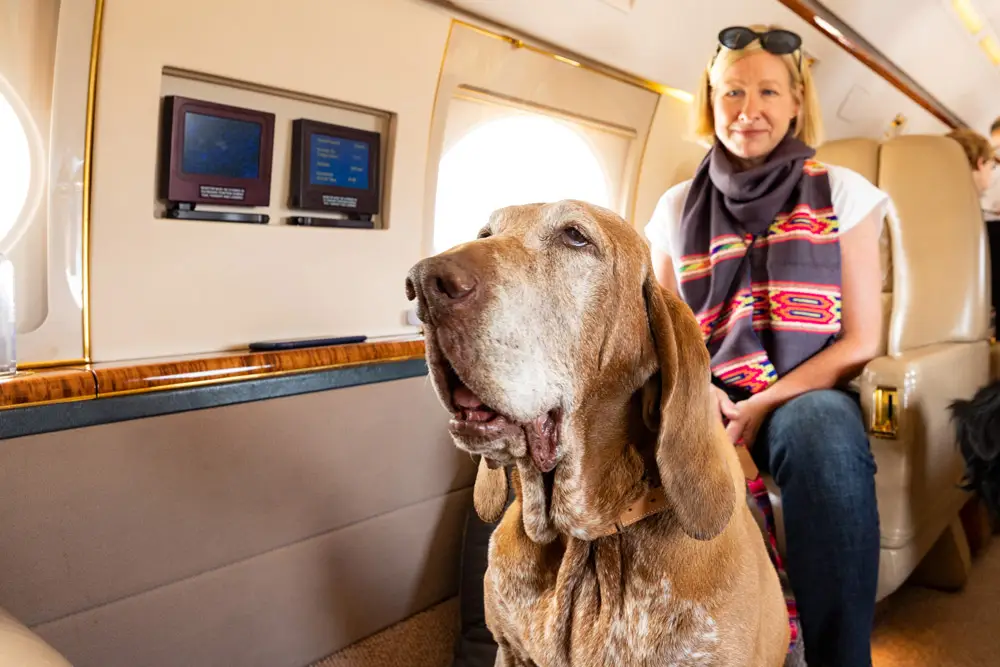
For owners who want to avoid the conventional large-crate process, PetAir offers access to in-cabin pet travel, delivered to you by K9 JETS. We operate pet-dedicated private jet flights where dogs can travel in the cabin alongside their owners.
The flights have no crate or size restrictions, and dogs can sit on a passenger’s lap or by their side. Your dog will have a dedicated seat right next to you.
That makes this option particularly interesting for large dogs, where a conventional airline crate can become one of the biggest logistical challenges of an international move.
The important point is that in-cabin travel does not remove the need for pet travel documentation. Your dog still has to meet the entry requirements of the destination country, breed restrictions or any other local rules may apply.
Please note: while the size of your dog does not matter, a specific aircraft may have a restriction on weight. Please speak to our friendly team to learn more about in-cabin travel requirements for your large dog.
Why in-cabin travel can be attractive for large breeds
- No need to source a very large airline crate for the flight.
- Your dog remains with you in the cabin rather than travelling as cargo.
- You can monitor your dog throughout the journey.
- It can simplify the practical side of travelling with very large dogs.
It is also worth remembering that private jet travel is not suitable or available for every route or every budget. Routes, dates, availability, passenger arrangements and pet acceptance are subject to change, so specialist advice is important before you make plans.
You can learn more about our in-cabin pet travel option here.
What paperwork does a large dog need to fly internationally?
The size of your dog does not usually determine the core import documentation. The destination country does. Requirements can include microchipping, rabies vaccination, an animal health certificate or export health certificate, parasite treatment, blood tests, import permits and specific timing rules.
For travel from Great Britain to a non-EU country, an Export Health Certificate and Export Application may be required, with additional requirements set by the destination country. Returning to Great Britain can also involve specific requirements depending on where your dog has travelled.
- Check the destination country’s official import rules.
- Make sure your dog’s microchip and vaccination records are correct.
- Work backwards from your travel date because some treatments and certificates have strict validity windows.
- Use a pet travel specialist if you are unsure which documents apply.
Our team at PetAir can guide you through all the necessary steps to relocate your pet safely.
How to prepare a large dog for international travel
- Start early:
International pet travel can involve several stages, so avoid leaving everything until the last few weeks. Earlier planning gives you more choice of routes and time to deal with unexpected requirements.
- Get your dog travel-ready:
Your vet can advise on your dog’s fitness for travel and any health considerations relevant to the journey. Do not give sedatives simply to make a flight easier unless specifically advised by your veterinary professional. Sedation can affect an animal’s ability to cope with transport and changes in pressure and environment.
- Consider your dog’s temperament:
Think about how your dog copes with unfamiliar people, airports, journeys and new environments. For dogs that are anxious about travel, discuss preparation and appropriate support with your vet well in advance. PetAir provide 24/7 online vet access prior to flights which includes crate training and behavioural advice. Learn more about our online vet access here.
- Plan the whole journey:
The flight is only one part of international pet relocation. Think about transport to the airport, check-in or collection procedures, arrival arrangements, onward travel and what your dog will need when you reach your new home. Speak to our team at PetAir – we can advise you on your options, such as collection from your home and transportation to the departure airport.
Large dog air travel checklist
- Destination entry rules checked
- Microchip and vaccination records checked
- Required health certificates or export paperwork arranged
- Breed restrictions checked
- Airline or private jet pet acceptance confirmed
- Crate requirements checked if travelling as cargo
- Dog prepared for the journey
- Arrival and onward transport arranged
- Return-to-UK requirements checked if you are travelling temporarily
Frequently asked questions:
Can a 30 kg dog fly internationally?
Yes. Weight alone does not determine whether your dog can travel. On many scheduled airlines, a dog of this size will usually travel as cargo. However, in-cabin private jet options can provide an alternative, subject to route, breed and booking requirements.
Can a 40 kg or 50 kg dog fly internationally?
Yes. However, some airlines may have specific restrictions on pet weight. If your dog is a very large breed, it is worth considering in-cabin pet travel via private jet for more flexibility. Speak to our team at PetAir for further advice.
Does a large dog need a large crate to fly?
If your dog is travelling as cargo, an airline-approved crate is required and must be large enough for your dog to stand, sit, lie down and turn around naturally. An in-cabin flight avoids the conventional airline crate requirement.
Is it safer for a large dog to fly in the cabin?
Cabin travel can allow an owner to remain with their dog and monitor them throughout the journey, but every pet and route is different. Your dog’s health, temperament, destination requirements and the specific aircraft and operator should all be considered before deciding how to travel.
Can giant breeds travel internationally?
Yes, giant breeds can travel internationally, but route and transport options can be more limited. Large crates, airline acceptance policies and destination breed restrictions all need to be considered. Private in-cabin options can be particularly useful where available.
How early should I arrange international travel for a large dog?
As early as possible. Some destinations have multi-stage health and documentation requirements, while large-dog transport can also sometimes lead to less availability. Early planning gives you time to prepare your dog and arrange a suitable crate.
PetAir: expert help for large-dog international travel
Large dogs do not have to make international relocation impossible. The right option depends on your destination, dog, dates and priorities.
PetAir is owned and run by veterinary professionals and has safely relocated more than 33,000 pets to over 300 destinations worldwide. For large dogs, our team can help you explore your transport options, whether than be pet travel in the hold or in-cabin.
Click below to get a quick quote for your pets travel journey.